





DISASTER RELIEF RESOURCES
Click the icons below to access helpful resources for disaster preparedness, monitoring, and recovery.
Please note, Disaster Resource Maps are located under the ‘Recovery’ section.
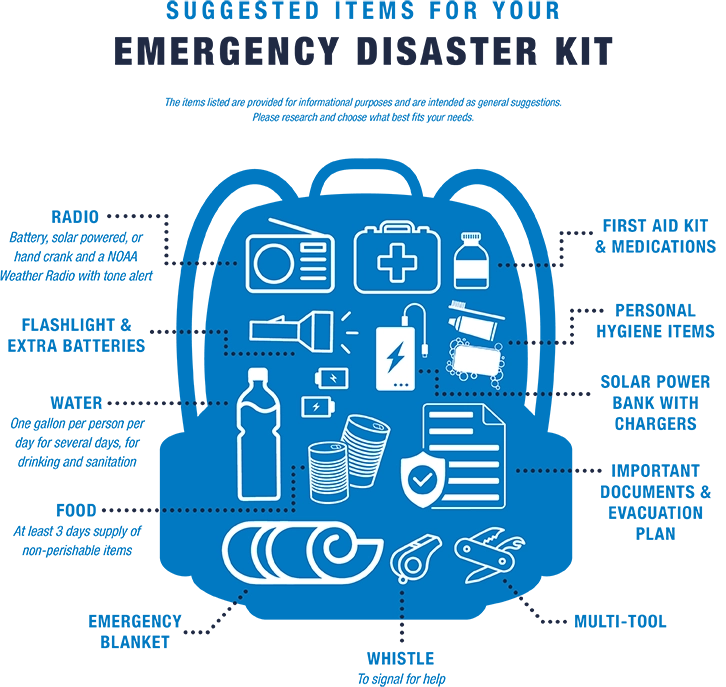
Build A Kit
Use the disaster preparedness guides below provided to help create your own preparedness kit.
Storm Shelter Map
Use the map below to locate community storm shelters in your area.
If you do not see one listed, reach out to your local county Emergency Management Agency
IMPORTANT: Please note that not all locations may be open for all events. Confirm in advance with your designated shelter that they are open, and ensure you allow adequate time to reach the location. If a tornado warning is issued, it may already be too late.
Counties are listed for contacting local governments or EMA’s.
Map created by Dr. Craig Ceecee, Meteorologist
How To Prepare For Different Disasters
Whether a disaster is a caused by a geological event or weather-related, here are some tips on how to stay prepared.
AVALANCHES
- Know the signs of an avalanche
- Shooting cracks across slopes
- Slopes that are steeper than 30 degrees
- Recent avalanches in an area
- There is a higher risk for avalanches from December through March
- Check avalanche forecasts.
- Recreating in an avalanche prone area(holiday, leisure, vacationing)
- Be sure to have an avalanche beacon, helmet, avalanche probe, shovel and avalanche airbag.
- Never travel alone.
- If you live in an avalanche prone area
- Make an evacuation plan.
- Have your emergency preparedness kit ready for evacuation .
- Sign up for local emergency alerts.
- Know how to spot the signs of an avalanche.
- What to do if you are stuck in an avalanche
- Remain calm.
- Try and keep your head above the surface or create an air pocket in the snow, lack of oxygen is one of the biggest risks in an avalanche.
- Deploy your airbag to try and stay on top of the snow slide.
- Attempt to get off the snow slab, aim 45 degrees down the slope and move across the flow of snow. Try to grab trees or branches to help pull you out.
- Call 911 if possible.
BLIZZARDS & EXTREME COLD
Types of Winter Storm Alerts
- Winter Storm Warning
- Hazardous winter weather such as heavy snow, freezing rain or heavy sleet are imminent or occurring. Usually issued 12-24 hours before severe weather is forecasted. Make a plan and seek shelter immediately. Stay off the roads if possible.
- Winter Storm Watch
- Possibility of a blizzard, heavy snow, heavy freezing rain or heavy sleet. Issued 12-48 hours before the beginning of a winter storm. Begin to prepare.
- Winter Weather Advisory
- Issued for accumulations of snow, freezing rain or freezing drizzle. Could cause significant inconveniences and travel delays. If caution is not exercised, could be life threatening.
Before Winter Weather
- Have your emergency kit prepared.
- If winter weather is forecasted, be sure to have food and water available in case you are unable to travel from your home.
- Keep a preparedness kit in your vehicle in case winter weather occurs while you are driving. Additional items to consider keeping in your vehicle to prepare include:
- Matches to melt snow in case drinking water freezes, candles for light/heat
- Blankets or a sleeping bag
- Sand or cat litter to increase traction if you are stuck in the snow
- Tire chains in case you are stuck in the snow or ice
- Shovel to help remove snow
- Tow rope in case you must be pulled out of snow or a ditch
- Jumper cables
- Compass and roadmaps
During Winter Weather
- Stay off roadways, if you are in your car and cannot drive safely, stay in your car to reduce risk of hypothermia.
- Limit your time outside. If you are outdoors, be sure to wear adequate layers of warm clothing to reduce your risk of frostbite.
- Signs of hypothermia: Unusually low body temperature
- Any temperature under 95 degrees is an emergency
- Shivering, exhaustion, confusion, fumbling hands, memory loss, slurred speech or drowsiness.
- What to do: Get to a warm room, remove all wet clothing. Keep dry and wrap up in blankets, especially around the head and neck. Seek medical attention if person loses consciousness or condition does not improve.
- Signs of frostbite: loss of color and feeling around face, fingers and toes.
- Numbness, white or grayish yellow skin, firm or waxy skin.
- What to do: Find a warm room, soak in warm water. Avoid massaging the affected areas or using a heating pad. If condition does not improve, seek medical attention.
DROUGHTS
Before a Drought
- Utilize water conservation tactics both indoors and outdoors such as:
- Fix dripping faucets.
- Check for plumping leaks and insulate water pipes.
- Choose water efficiency appliances.
- Consider rainwater harvesting for gardens.
During a Drought
- Indoor water conservation
- Avoid unnecessary flushing of toilets.
- Take short showers and avoid baths.
- Avoid letting water run when brushing your teeth, washing your face or shaving.
- Only operate washing machines when fully loaded.
- Only use the dishwasher when fully loaded, use a “light wash” setting to conserve water.
- Outdoor water conservation
- In extreme drought, avoid watering lawns and preserve trees and large shrubs.
- Water gardens in short sessions to avoid runoff.
Extreme Drought:
- During extreme drought conditions, communities may put limitations on water usage or prohibit the use of water outside of necessities.
EARTHQUAKES
- Prepare your home
- Secure heavy items, such as bookcases, refrigerators, water heaters, televisions and objects that hang on wall. Store heavy or fragile objects on low shelves.
- If your home has any structural issues, consider having those resolved to decrease the likelihood of building collapse.
- During an earthquake
- Stay inside, avoid outdoors and doorways.
- If you are outside, move to an open area away from buildings, trees, streetlights and power lines. Drop and cover until shaking stops.
- If you are in bed, turn face down and cover your head and neck with a pillow.
- If you are in a vehicle, pull over and set your parking brake.
- Protecting yourself
- Drop to your hands and knees and hold onto something sturdy. If you are in a wheelchair, make sure you lock your wheels.
- Cover your head and neck with your arms. If a sturdy table or desk is nearby crawl underneath for shelter. If no shelter is available, move against an interior wall with no windows.
- After an earthquake
- Expect aftershocks, which are lower intensity quakes that occur after an earthquake.
- If the building you’re in is damaged, go outside and quickly move away from the structure. Do not enter any damaged buildings.
- If you are trapped, try sending a text, banging on a wall or pipe. Instead of shouting, use a whistle.
- If you live in a coastal area or an area prone to tsunamis, go inland or to higher ground as soon as shaking stops. Earthquakes can be triggers for tsunamis.
EXTREME HEAT WAVES
Before a heat wave
- Identify areas in your community that are used as cooling stations during periods of high temperatures. This usually includes libraries, public transportation, shopping malls etc. You can contact your local health department to find this information.
- Cover windows with drapes or shades to reduce the temperature inside.
- Weather strip doors and windows to help reduce strain on you A/C and other cooling systems.
- Use window reflectors.
- Install window air conditioners and insulate around them.
- If you are unable to afford the cooling costs or weatherization needed for your home, contact the Low Income Home Energy Assistance Program for help.
During a Heat Wave
- Do not leave people or pets in a closed car on a hot day.
- If your A/C stops working or is unavailable, get to a cooling station.
- Take cool showers.
- Wear loose, lightweight, light-colored clothing.
- Limit oven and stove usage to reduce the temperature in your home.
- Be sure to stay hydrated and drink plenty of water, even if you are not doing physical activity.
Heat Related Illnesses
- Heat Stroke:
- Extremely high body temperature (over 103 degrees using an oral thermometer)
- Red, hot skin with no sweat
- Rapid, strong pulse
- Dizziness, confusion or unconsciousness
- Call 911 or seek medical attention immediately, this is a medical emergency.
- Move the affected individual into a cool, shaded area. Remove any outer clothing and elevate their feet. Place a cold, wet cloth or ice pack on the head, neck, armpits and groin.
- Heat Cramps:
- Muscle pain or spasms in the stomach, arms or legs
- Get to a cooler location, rehydrate and remove excess clothing. Call your healthcare provider if symptoms worsen or last longer than an hour.
- Heat Exhaustion:
- Heavy sweating, paleness, muscle cramps, tiredness, weakness, fast or weak pulse, dizziness, headache, fainting, nausea, vomiting
- Get to a cooler location, rehydrate and remove excess clothing. Contact your healthcare provider if symptoms worsen or last longer than an hour.
FLOODS
- Preparing for a flood
- Know your risk by checking FEMA’s Flood Map Service Center.
- Have an evacuation plan and go over it with your family.
- Have your preparedness kit on hand.
- Protecting your home/property
- Declutter drains and gutters.
- Get flood insurance.
- Consider a battery-operated sump pump.
- Have sandbags on hand to place in-front of low-lying doorways and drains to prevent water from entering into your home.
- Review this in-depth guide from FEMA.
- During a flood
- Evacuate immediately if given an evacuation warning by officials.
- Listen to emergency alert systems, NOAA Weather Radio and local alerting systems to get up-to-date emergency information.
- Never drive around barricades. Do not walk, swim, or drive through flood waters.
- Stay off bridges that are over fast-moving water. Bridges can become damaged or washed away without warning.
- If you are inside your car and trapped by flood waters, stay inside of the vehicle. If water is rising, get on top of the vehicle.
- If trapped in a building, get to the highest level. Only get onto the roof if necessary or to signal for help. Do not climb into an enclosed attic space.
- After a flood
- Only return home when officials say it is safe.
- Avoid driving unless it is an emergency.
- There is a high risk of electrocution after a flood. Be aware of downed powerlines, wet electrical equipment or equipment left in standing water. Turn off electricity to prevent injury until it is safe.
- Avoid floodwater, it can be contaminated and contain debris. Underground or downed powerlines can electrically charge the water.
- Only use a generator outdoors and away from windows to avoid carbon monoxide exposure.
- When cleaning up, wear protective equipment, including gloves and face masks.
- Be aware of mold growth after a flood, be sure to wear a face mask and those with lung conditions or who are immunocompromised should avoid buildings where mold can be seen or smelled.
HURRICANES & TROPICAL STORMS
Before a Hurricane or Tropical Storm
- Have a way to receive emergency weather notifications. NOAA Weather Radios will alert you of all weather hazards. You can also sign up for local alerts on your phone through your city/county.
- Understand the difference between Advisory, Watch or Warning
- Advisory- Issued when storm conditions are forecasted to cause significant inconveniences that could be hazardous. If caution is used, these situations should not be life-threatening.
- Watch- Issued when a storm/hurricane is possible in the next 48 hours. Continue to monitor these alerts, stay aware and have emergency supplies prepared.
- Warning- Issued when a storm/hurricane is expected in the next 36 hours. Continue to monitor alerts, complete storm preparations and follow all evacuation orders.
- Evacuation Plans
- You can find evacuation routes through your states’ Department of Transportation or your local Emergency Management Office. Emergency shelters are located on the FEMA app. Once you know your evacuation route and shelter locations, be sure to share this information with your household before a hurricane hits.
- Make plans that include your entire household, including children, those with disabilities and pets.
- Always keep your gas tank at least half full with fuel and keep basic emergency supplies in your vehicle.
- Have an out-of-state contact your household can call and check-in with.
- Have a designated meeting spot in case you are separated from those in your household.
- Have your disaster preparedness kit ready to go.
- Protecting your property
- You can reduce the risk of damage from high winds by reinforcing doors, windows, walls and roofs. For example, boarding up windows and doors.
- Reduce the risk of wind-borne debris by bringing outdoor furniture, garbage cans, bicycles etc. inside. Anchor items that cannot be brought inside such as grills and propane tanks. Trim or remove trees close enough to fall on your home.
- You can reduce the risk of flood water entering your home by clearing gutters and drains, waterproofing the basement, installing water alarms and battery back-up sump pumps and using sandbags.
- Consider flood insurance on your home.
During a Hurricane or Tropical Storm
- Sheltering in place or evacuating
- If authorities advise or order you to evacuate, leave as soon as possible. Do not ignore evacuation orders if you are able to leave.
- If you do not have an evacuation notice, stay indoors away from windows or glass doors. If you are in a temporary shelter, move to a sturdier building.
- If you are in an area prone to flooding, move to higher ground before flood waters begin to rise.
- Do not use generators, gas powered equipment, grill, camp stove or coal burning device indoors or in an enclosed area.
After a Hurricane or Tropical Storm
- If you have evacuated the area, wait for officials to declare the area safe before returning.
- Do not wade in flood waters. Flood waters can contain dangerous debris such as downed powerlines, metal, dead animals, sewage, gasoline and oil.
- Do not enter a building until it has been inspected. Wear personal protective equipment when cleaning debris.
- Do not use electrical equipment if it is wet or you are standing in water.
- Avoid drinking tap water until you know it is safe. If you are unsure, boil or purify water first.
- Clean and disinfect everything that got wet. Mud from floodwaters can contain sewage, bacteria and chemicals.
LANDSLIDES & MUDSLIDES
Causes of Landslides
- Heavy rain and waterlogged soil
- Erosion
- Steep slopes
- Earthquakes
- Wildfires
Before a landslide or mudslide
- Have your disaster preparedness kit ready.
- Have an evacuation plan for your household
- Sign up for emergency alerts
- Consult a professional on preventative measures for your home.
- In mud or debris flow areas, consider building channels or deflection walls to direct the flow around buildings.
- Consider flood insurance
Recognize warning signs
- If you live near a wildfire burn area, pay attention to weather forecasts for the burn area. These burned landscapes can pose a higher risk for landslides.
- Listen and watch for rushing water, mud or other unusual sounds.
- Trees cracking or boulders knocking together could indicate moving debris. A faint rumbling sound that increases in volume occurs as a landslide gets closer.
- Large boulders in a landscape can be signs of past debris flows.
- If you are near a stream or channel, be alert for any sudden increase or decrease in water flow or water that changes from clear to muddy. This can be a sign of an incoming landslide.
During a landslide
- Stay awake and alert during a storm that could cause a landslide.
- If a debris flow is already coming, you will not be able to get away from the flow safely. Never cross a road with water or mud flowing.
- Avoid river valleys and low-lying areas during risk of landslide.
- If you get stuck in the path of a landslide, move uphill as quickly as possible.
After a Landslide
- Stay away from the area, additional slides may be possible.
- Stay up to date on local emergency alerts.
- Be aware of possible flooding. Oftentimes the same conditions that cause landslides can also cause flooding.
- Check for injured or trapped people near the slide, do not enter the direct area. Alert rescuers or 911.
- Report broken utility lines, downed powerlines and damaged roadways.
- Have a professional inspect damaged buildings before entering.
TORNADOES & SEVERE STORMS
Before a tornado or severe weather system
- Know your risk of tornadoes. The Midwest and Southeast portions of the US are at greater risk for tornadoes.
- Have your disaster preparedness kit ready.
- Know the signs of a tornado, including a rotating, funnel-shaped cloud, clouds of debris and a loud roar which can sound like a freight train.
- Sign up for emergency alerts and pay attention to weather reports. Meteorologists are often able to warn people of incoming tornadoes.
- Know the safe area in your home, whether it is a FEMA standard storm shelter, basement or enclosed room with no windows.
During a tornado
- In your home: Immediately go to your safe location. This includes the lowest level interior room with no windows (such as a bathroom), a basement, cellar or storm shelter. Stay close to the center of the room.
- In a mobile home: Evacuate the mobile home immediately, if possible, even if the unit has been tied down and take shelter in a building with a string foundation. If that is not available, lie in a ditch or low-lying area a safe distance away from the home.
- At work or school: Go to a basement or inside hallway at the lowest level of the building. Avoid large open spaces such as auditoriums, cafeterias, gyms or shopping malls. Try and shelter under a sturdy piece of furniture like a desk or heavy table.
- If you are outdoors: If it is not possible to get inside a building, lie in a ditch or low-lying area or crouch near a strong building.
- If you are in a vehicle: Do not try and “outrun” a tornado. They can change direction quickly and lift a vehicle through the air, off the ground. If you are unable to get shelter inside a building, get out of the vehicle and lie in a ditch or low-lying area away from the vehicle.
- Protect your head and neck with a helmet, a blanket or by covering your head with your arms in a crouched position.
TSUNAMIS
Know your risk
- Tsunamis can affect any US coast, but the Pacific and Caribbean coastlines are at the greatest risk.
Signs of a Tsunami
- If you are near the coast, an earthquake could trigger a tsunami. As soon as the shaking stops, move to your tsunami safe zone.
- A loud roar from the ocean, unusual ocean behavior such as a sudden rise or wall of water or sudden retreat of water could be a sign of a tsunami. If you see any of these signs, immediately move to your safe zone. Do not wait for an official alert.
Before a Tsunami
- Communities at risk for tsunamis have evacuation plans and safe zones designated. Learn these routes before a tsunami occurs.
- If your community does not have an evacuation plan, identify a safe place that is at least 100ft above sea level or 1 mile inland.
Tsunami alerts
- Tsunami information statement: an earthquake has occurred, but no threat has been identified. Or the earthquake was very far away, and a tsunami threat has not yet been identified. Continue to monitor local alerts.
- Tsunami watch: A distant earthquake has occurred, and a tsunami is possible. Stay aware and continue to monitor local alerts. Prepare to evacuate if needed.
- Tsunami advisory: A tsunami with dangerous currents/waves is expected or occurring. Take action and stay away from beaches. Follow instructions from local officials.
- Tsunami warning: A tsunami is occurring. Take immediate action and move to your safe spot away from the water.
After a tsunami
- If you evacuated from the area, wait until officials deem the area safe before you return. It could be days before you can safely return.
- Avoid floodwaters, downed powerlines and hazardous debris can cause injury or death.
- Wait to return to affected buildings until a professional has completed an inspection.
- Use proper PPE during cleanup.
VOLCANIC ERUPTIONS
Before an eruption
- Know your area’s risk from volcanic eruption. Know your distance from an active volcano.
- Have your disaster preparedness kit ready.
- Sign up for emergency alerts from the volcano notification service.
- Have an evacuation plan prepared with your household. Have a ‘shelter in place’ plan if your biggest risk is ash fall.
During an eruption
- Follow evacuation alerts from local authorities, evacuate as early as possible. Do not wait.
- Avoid areas downwind and river valleys downstream of the volcano. Rubble and ash will be carried by wind and gravity.
- Shelter in place from volcanic ash if you have enough supplies. Cover ventilation openings and seal doors and windows.
- If you are outside, falling ash can cause skin irritation and breathing problems. Use proper PPE such as an N95 mask.
- Avoid driving during heavy ash fall.
After an eruption
- Listen to local authorities and alerts to find out when it will be safe to return home or go outdoors.
- Avoid driving in heavy ash. Driving can stir up volcanic ash and clog engines; ash is also very slippery and can reduce traction.
- Avoid all contact with ash if you have a history of breathing problems.
- Do not get on your roof to remove ash. If you have to remove ash, use extra precaution as ash can be very slick.
- Wear proper PPE during clean up, specifically a mask or respirator.
WILDFIRES
Before a wildfire
- Have several ways to receive emergency alerts.
- Pay attention to red flag warnings in your area, this can alert you to weather conditions that could cause fire to spread rapidly.
- Be aware of burn bans in your area and follow the direction of authorities.
- Have your evacuation plan and disaster preparedness kit ready for your household. Keep an n95 mask in your kit for each member of your household to help reduce smoke inhalation.
- If you live in a wildfire prone area, look into strengthening your home.
- Use fire resistant materials to build, renovate or make repairs.
- Have an outdoor water source with a hose that can reach any area of your property.
- Have a fire-resistant zone at least 30 feet around your home that is free of leaves, debris, and other flammable materials.
- Designate a room in your home that can be closed off from outside air, close all doors and windows.
- Have a portable air cleaner to keep indoor pollution levels low when there are high amounts of smoke in the air.
During a wildfire
- Evacuate immediately if ordered by authorities.
- If you are trapped, call 9-1-1 and give your location. Emergency responses could be delayed. Turn on lights, if possible, to help rescuers find you.
- Reduce smoke inhalation
- Wear an n95 mask if you have one on hand.
- If you do not have a mask, shelter in place in a room closed off from outside air with a portable air purifier.
- If your central air system has a “recirculate” mode, turn that on to reduce outdoor air intake.
After a wildfire
- If you had to evacuate, do not return home until officials declare the area safe.
- Avoid hot ash and smoldering debris. The ground may contain heat pockets that can cause injury or spark another fire if disturbed.
- Wear PPE during clean-up, including masks, sturdy shoes and clothing that covers your arms and legs.
- Document all property damage using photos.
The resources and recommendations on this page are provided by Matthew 25: Ministries based on our experience in disaster relief and preparedness and are presented are provided for informational purposes only. We do not endorse, support, or assume responsibility for any non-weather-related opinions, views, or content expressed by these sources. Individuals are encouraged to conduct their own research to assess the specific risks relevant to their areas and to determine their unique preparedness needs.
Severe Weather Live Feeds
Monitoring Resources
Click the links below to access helpful weather and disaster monitoring resources.
Weather EXPERTS List
AccuWeather
@accuweather
BAM Weather
@bam_weather
DisasterAWARE
@disasteraware
Jim Cantore
@JimCantore
Mike Bettes
@mikebettes
Mike Seidel
@mikeseidel
Mike's Weather Page
@tropicalupdate
NASA Earth
@NASAEarth
National Hurricane Center
@NHC_Atlantic
NOAA Communications
@NOAAComms
NWS Severe Tstorm
@NWSSevereTstorm
NWS Storm Prediction Center
@NWSSPC
NWS Tornado
@NWStornado
RadarOmega
@RadarOmega
Severe Warnings
@severewarn
Reed Timmer, PhD
@ReedTimmerUSA
The Weather Channel
@weatherchannel
WeatherNation
@WeatherNation
The resources and recommendations on this page are provided by Matthew 25: Ministries based on our experience in disaster relief and preparedness and are presented are provided for informational purposes only. We do not endorse, support, or assume responsibility for any non-weather-related opinions, views, or content expressed by these sources. Individuals are encouraged to conduct their own research to assess the specific risks relevant to their areas and to determine their unique preparedness needs.
DISASTER RELIEF RESOURCE MAPS
Following a natural disaster, access to clear and accurate information is incredibly important. In the midst of the initial recovery, it is difficult to maneuver the many news and social media outlets to find what supplies or services are needed most.
Matthew 25: Ministries has created the collection of maps below for major disasters that have occurred in the United States. These maps give a list of resources available to those working to recover from a tornado, hurricane, flood, wildfire, earthquake, and more. Matthew 25 has compiled this data from a variety of reputable sources and put it into easy to access maps that are sorted by the disaster. Each map has a collection of locations where individuals can go to receive supplies, services, or additional information or support.
Resource maps will display below when available.
Each map is updated daily during the recovery process for at least one month after the disaster occurs, or as long as reliable information can still be found.
Matthew 25 has compiled this information from a variety of reputable sources, but does not have any direct affiliation with the groups or services unless otherwise noted. For questions about the locations and services they offer, please contact the locations directly. By using this resource, you are acknowledging this statement and agree not to hold Matthew 25: Ministries or our partners liable for any information that is found to be incorrect.
RESOURCE MAPS VIDEO TUTORIAL
The resources and recommendations on this page are provided by Matthew 25: Ministries based on our experience in disaster relief and preparedness and are presented are provided for informational purposes only. We do not endorse, support, or assume responsibility for any non-weather-related opinions, views, or content expressed by these sources. Individuals are encouraged to conduct their own research to assess the specific risks relevant to their areas and to determine their unique preparedness needs.
11060 Kenwood Road
Blue Ash, OH 45242
11083 Kenwood Road
Blue Ash, OH 45242
Subscribe To Our Newsletter




© Copyright 2026 | Matthew 25 Ministries. All Rights Reserved. Cincinnati Web Design